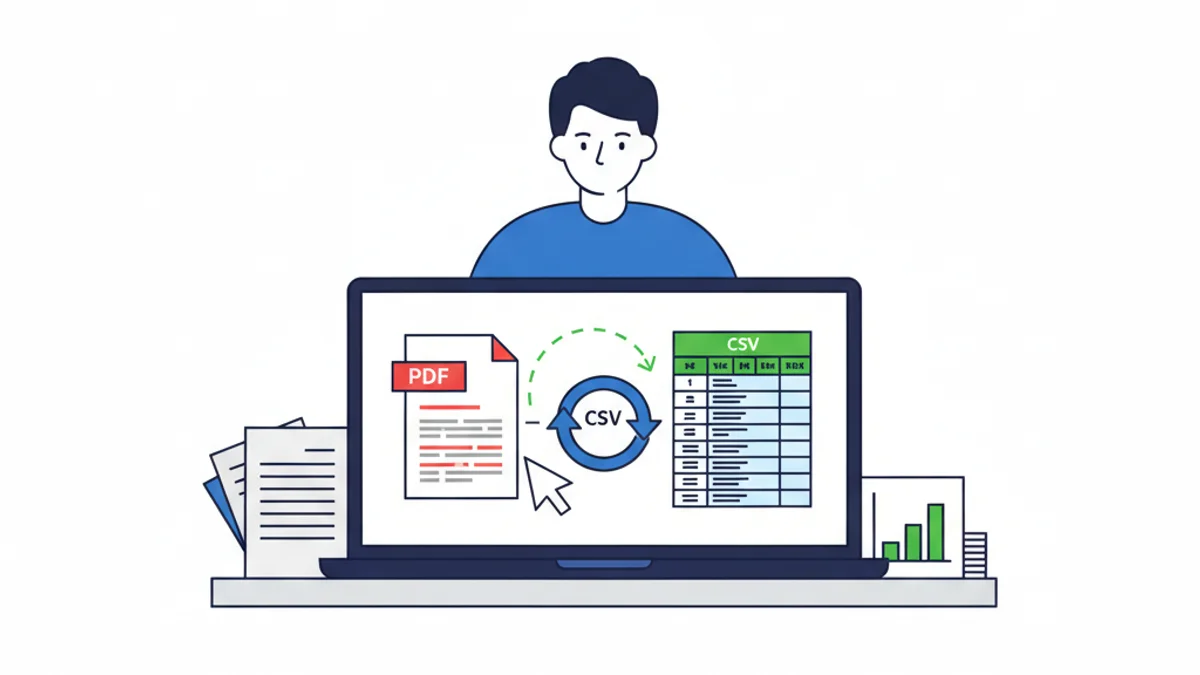
Converting an HSBC bank statement from PDF to CSV takes under two minutes when you use the right tool. HSBC's personal and business accounts both generate PDF statements that cannot be imported directly into accounting software like Xero, QuickBooks, or Sage. To use your transaction data, you need to convert it to CSV or OFX format first. This guide walks you through exactly how to do that, what to watch out for in HSBC's PDF layout, and how to get clean data ready for your accounts.
Why HSBC PDFs Are Awkward to Work With
HSBC UK generates statements in a multi-column PDF format. The standard layout includes the transaction date, a description field, a debit column, a credit column, and a running balance. That sounds straightforward, but PDF files store data as visual positions on a page, not as structured rows and columns. Copy and paste the text from an HSBC PDF into a spreadsheet and you will almost certainly end up with garbled columns, merged cells, or missing figures.
This is not unique to HSBC. It is a fundamental limitation of the PDF format. The fix is a proper PDF-to-CSV converter that understands the table structure of bank statements specifically, rather than a generic PDF reader.
HSBC business accounts also produce statements with more complex layouts than personal accounts, often including multiple account numbers on a single statement or sub-account references. A converter built for bank statements handles these edge cases; a generic tool usually does not.
How to Download Your HSBC Statement as a PDF
Before you can convert anything, you need the PDF. Here is how to get it from HSBC online banking:
- Log in to HSBC UK Online Banking
- Select the account you want the statement for
- Go to Statements in the left-hand menu
- Choose the date range or statement period
- Select Download and choose PDF format
- Save the file to your computer
HSBC allows you to download statements going back up to seven years for most account types. For business accounts, the process is similar through HSBC Business Banking, though the navigation labels differ slightly.
One thing to check before converting: make sure you have downloaded the full statement, not a filtered transaction view. Filtered views sometimes omit the running balance column, which can cause formatting issues during conversion.
How Do You Convert an HSBC PDF Statement to CSV?
The fastest method is to use a dedicated bank statement converter. Here is the step-by-step process using convertbank-statement.com's converter tool:
- Go to the converter and select HSBC as your bank
- Upload your downloaded PDF statement
- Choose your output format: CSV, Excel (XLSX), or OFX
- Review the preview to confirm columns have mapped correctly
- Download your converted file
The converter recognises HSBC's column layout automatically, so the date, description, debit, credit, and balance fields land in the correct columns without manual adjustment.
For a CSV file, the output uses standard headers: Date, Description, Debit, Credit, Balance. Most UK accounting software accepts this format directly.
What Output Format Should You Choose?
The right format depends on your accounting software:
| Software | Recommended Format | Notes |
|---|---|---|
| Xero | OFX or CSV | Xero's bank import accepts both; OFX preserves more metadata |
| QuickBooks Online | CSV or OFX | Use the QuickBooks CSV template if mapping manually |
| Sage 50 | CSV | Sage requires specific column order; confirm headers match |
| FreeAgent | CSV | FreeAgent accepts a simple 3-column date/description/amount CSV |
| FreshBooks | CSV | Manual import via the transactions section |
| Excel / Google Sheets | CSV or XLSX | XLSX preserves formatting if you are working in spreadsheets |
If you are submitting data as part of Making Tax Digital (MTD) compliance, your bridging software or accountant will likely ask for CSV. HMRC's MTD for Income Tax Self Assessment (ITSA) applies to sole traders and landlords with income over £50,000 from April 2026, and to those earning over £30,000 from April 2027. Clean CSV files make that process considerably easier.
What About HSBC's Own Export Options?
HSBC does offer some built-in export functionality, but it has limitations worth knowing about.
For personal accounts, HSBC's online banking lets you export transactions in OFX or CSV format directly, but only for a rolling 12-month window. If you need statements older than 12 months, you will need to download the PDF version and convert it.
For business accounts, HSBC Connect and HSBC Business Internet Banking offer data exports, but availability depends on your account type and whether your business uses HSBC's API banking or standard online banking portal.
The direct export route is worth trying first if your data falls within the available window. For anything outside that window, or if the direct export produces incomplete data, converting the PDF is the reliable fallback. You can compare your options in the best bank statement converter guide for 2026.
Common Problems When Converting HSBC Statements
A few issues come up regularly when people convert HSBC PDFs:
Merged description text: HSBC sometimes wraps long merchant names across two lines in the PDF. A good converter handles this by joining the lines, but a basic one may split them into separate rows. Always check your description column after conversion.
Debit and credit in separate columns: HSBC uses a split debit/credit layout rather than a single signed-amount column. Some accounting software prefers a single amount column with negative values for debits. Check what your software expects before importing.
Statement headers repeating mid-file: Multi-page PDFs sometimes carry the column headers on every page. These can appear as duplicate rows in your CSV. Delete any rows where the "Date" field contains the word "Date" rather than an actual date.
Date format: HSBC UK PDFs use DD/MM/YYYY format. If your accounting software is set to US date format (MM/DD/YYYY), dates will import incorrectly. Confirm your software's regional settings are set to UK before importing.
Step-by-Step: Getting Your HSBC CSV Into Xero
Once you have your CSV file, importing into Xero takes about three minutes:
- In Xero, go to Accounting > Bank Accounts
- Select the relevant bank account
- Click Import a Statement
- Upload your CSV file
- Map the columns if prompted: Date, Payee, Description, Amount (or separate Debit/Credit)
- Click Import and review the transactions
Xero will flag any transactions that overlap with existing imported data, so there is no risk of duplicating entries if you have already imported some transactions via an open banking feed.
For QuickBooks Online, the process is similar under Banking > Upload transactions. Sage 50 users should use the Bank > Import Statement option and confirm the CSV column order matches Sage's required template.
If you process statements regularly for multiple clients or accounts, convertbank-statement.com's pricing plans include batch conversion options that save significant time compared to converting files one at a time.
Sarah Mitchell is a chartered management accountant with over 12 years of experience supporting UK small businesses and sole traders with bookkeeping, VAT returns, and HMRC compliance. She has worked extensively with cloud accounting platforms including Xero, QuickBooks, and FreeAgent.
Frequently Asked Questions
Can I convert an HSBC PDF statement to CSV for free?
Yes. convertbank-statement.com offers free conversions for single files, with no account required. Paid plans are available if you need to convert multiple statements regularly or in bulk.
How far back can I get HSBC statements to convert?
HSBC allows PDF statement downloads going back up to seven years through online banking for most account types. Once you have the PDF, you can convert any statement regardless of age.
Will the converted CSV work with HMRC's Making Tax Digital requirements?
Yes. A CSV file converted from your HSBC statement can be used with MTD-compatible bridging software or uploaded directly into MTD-ready accounting platforms. HMRC's MTD for ITSA applies to those with self-employment or property income above £50,000 from April 2026.
Why does my HSBC CSV have blank rows or repeated headers?
This usually happens when the PDF converter reads the column header row that HSBC prints on each page of a multi-page statement. Delete any rows where the Date column contains the text "Date" rather than an actual date value.
Does HSBC use a different PDF format for business accounts?
HSBC business account statements have a slightly more complex layout than personal statements, sometimes including sub-account references or multiple account sections in a single PDF. A bank-statement-specific converter handles this better than a generic PDF tool.
What is the difference between CSV and OFX for bank statement imports?
CSV is a plain text format with columns separated by commas, widely accepted by all accounting software. OFX (Open Financial Exchange) is a structured format that includes additional metadata such as transaction IDs, which can help with automatic transaction matching in software like Xero. For most purposes, CSV is sufficient.
Last reviewed: 2026-03-13