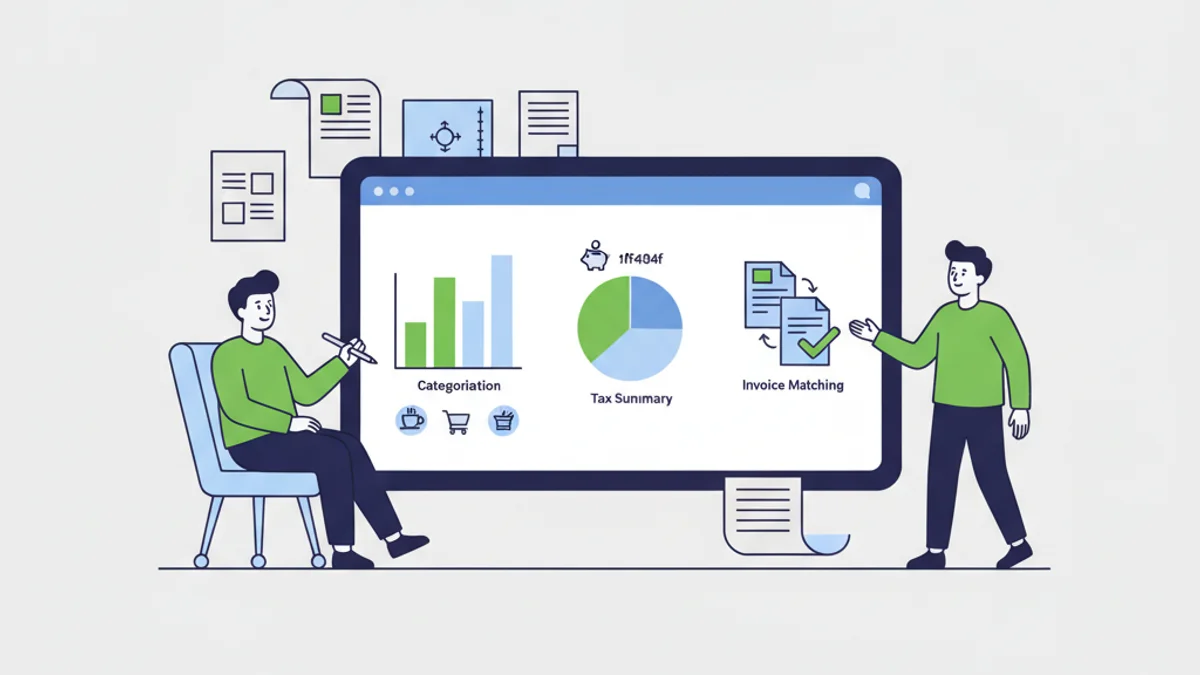
Embedded accounting is the practice of building accounting, bookkeeping, and tax compliance features directly into banking apps, fintech platforms, and SaaS tools, so small businesses can manage their finances without switching between separate products. For UK SMEs, this means banks like Starling, Monzo Business, and Tide are no longer just places to hold money: they are starting to handle categorisation, VAT tracking, and even HMRC-ready reporting natively. For accountants and bookkeepers, that shift changes the shape of day-to-day workflows, including how and when bank statement data needs to move between systems.
What Is Embedded Accounting and Why Does It Matter Now?
The idea is straightforward. Rather than a small business owner exporting a PDF from their bank, emailing it to their accountant, and waiting for someone to manually key figures into Xero or QuickBooks, the bank or fintech platform handles that connection automatically.
Open Banking infrastructure, introduced in the UK under the Payment Services Regulations 2017 and overseen by the Financial Conduct Authority (FCA), made this technically possible by requiring banks to open up data access via APIs. But the industry has taken time to move from raw data sharing to genuinely useful accounting features.
That move is now accelerating. Sage, one of the UK's largest accounting software providers, has been building partnerships with banks and payment platforms to embed its ledger and compliance tools directly inside third-party products. The result is that a business owner using a fintech current account can see categorised transactions, track expenses against budgets, and generate a P&L without ever opening a separate accounting package.
For context on scale: the UK has approximately 5.5 million small businesses, the majority of which still rely on spreadsheets or manual processes for bookkeeping, according to HMRC's own research into Making Tax Digital readiness. Embedded accounting targets exactly this group.
How Does Embedded Accounting Change Bank-to-Accounting Workflows?
The traditional workflow looks like this:
- Business owner logs into online banking
- Downloads a PDF or CSV statement
- Sends it to an accountant or bookkeeper
- Accountant converts or imports the file into accounting software
- Transactions are categorised manually
- Reconciliation happens at month end or quarter end
With embedded accounting, steps two through five collapse. The bank feeds data directly into the accounting layer in real time. Categorisation rules apply automatically. Reconciliation becomes a confirmation rather than a manual task.
This is already partly live in the UK. Starling Bank has a Xero integration that pushes transactions automatically. Tide offers built-in invoicing and expense tracking. Coconut, a fintech aimed at sole traders, was built from the ground up with embedded tax features for self-employed users.
The next phase goes further. Embedded accounting means the bank itself owns the accounting features, rather than routing data to a third-party tool. That is the distinction Sage and others are pushing toward through their embedded finance partnerships.
What Does This Mean for HMRC's Making Tax Digital Requirements?
Making Tax Digital for Income Tax Self Assessment (MTD for ITSA) becomes mandatory for sole traders and landlords with income over £50,000 from April 2026, and for those earning over £30,000 from April 2027. These thresholds were confirmed by HMRC in the December 2022 announcement.
MTD for ITSA requires quarterly digital submissions of income and expenditure data, not just an annual Self Assessment return. That creates a direct compliance driver for embedded accounting. If a sole trader's banking app can automatically track income and expenses and submit quarterly updates to HMRC, the compliance burden drops significantly.
You can read the full MTD for ITSA requirements on GOV.UK's Making Tax Digital guidance.
For accountants managing clients through this transition, embedded accounting tools at the bank level mean clients arrive with cleaner, more complete data. The accountant's role shifts from data cleaning toward advisory work.
But there is a gap. Not every client uses a fintech with embedded features. NatWest, Lloyds, HSBC, and Barclays remain the dominant business banking providers in the UK, and their accounting integrations are still relatively basic compared to the newer platforms. That gap is where manual bank statement conversion remains relevant.
Which UK Banks and Fintechs Are Leading on Embedded Accounting Features?
Here is how the main UK business banking options currently compare on embedded accounting capability:
| Bank / Fintech | Built-in Categorisation | Direct Accounting Software Integration | Tax / VAT Features | MTD-Ready Features |
|---|---|---|---|---|
| Starling Bank | Yes | Xero, FreeAgent, QuickBooks | Basic | Partial |
| Monzo Business | Partial | Xero (beta) | Limited | No |
| Tide | Yes | Xero, Sage, QuickBooks | Invoicing only | No |
| Coconut | Yes | Native (built-in) | Self-employed tax | Yes |
| NatWest | Limited | FreeAgent (bundled) | Limited | No |
| Lloyds Business | No | Manual CSV export | No | No |
| HSBC Business | No | Manual export | No | No |
| Barclays Business | Limited | Manual export / API | No | No |
This table reflects publicly available integrations as of March 2026. Features change: always check directly with your bank.
The established high-street banks are notably behind. If your clients bank with Lloyds, HSBC, or Barclays, they are still generating statements that need converting before they reach accounting software. That is not changing overnight.
What Should Accountants and Bookkeepers Do Right Now?
Embedded accounting will reshape workflows over the next three to five years, but the transition is uneven. Here is a practical approach for the current environment:
Audit your client bank mix. Find out how many clients use fintechs with live integrations versus high-street banks with manual exports. The split will tell you where you still need conversion tools in your workflow.
Set up direct feeds where they exist. For clients on Starling or Tide, get the Xero or QuickBooks integration connected. This removes the statement conversion step entirely for those clients.
Keep a reliable conversion process for the rest. For clients on Barclays, HSBC, Lloyds, or any bank that only provides PDF statements, you need a tool that accurately converts those files into CSV or OFX format for import. The bank statement converter at convertbank-statement.com handles PDFs from all major UK banks, including multi-column Barclays layouts and NatWest's paginated format.
Check conversion accuracy before importing. Even with good tools, always cross-check the opening and closing balance on the converted file against the original PDF. A £0.01 discrepancy will cause a reconciliation headache.
Plan for MTD. April 2026 is not far away for your higher-earning sole trader clients. If their bank does not offer MTD-compatible features, they need accounting software that does. See our comparison guide to bank statement converters in 2026 for an overview of tools that integrate with MTD-ready software.
Talk to clients about banking choices. This is not about pushing them to switch banks, but if a client is frustrated by manual bookkeeping and they are currently with a bank that offers no integration, it is worth raising that a switch to Starling or Tide could reduce their admin significantly.
You can also review AccountingWeb's coverage of open banking and SME accounting tools for ongoing updates from the UK accountancy community, and the FCA's open banking resources for the regulatory context.
For firms wanting to understand pricing for statement conversion at scale, the convertbank-statement.com pricing page sets out options for individual use through to accountancy practice volumes.
Embedded accounting is a direction of travel, not an arrival point. The platforms building native accounting tools are solving a real problem for small businesses, and that will reduce manual data handling over time. But the patchwork of bank types, client preferences, and legacy systems means conversion workflows will remain part of the accountant's toolkit for years to come. The practical response is to automate where you can, and have a reliable fallback where you cannot.
Sarah Mitchell is a UK-based bookkeeper and financial technology consultant with over eight years of experience helping small businesses and accountancy practices improve their bank-to-accounting workflows.
Frequently Asked Questions
What is embedded accounting?
Embedded accounting is the integration of bookkeeping, expense categorisation, and tax compliance features directly into a bank account, fintech app, or SaaS platform, rather than requiring businesses to use a separate accounting package.
Which UK banks currently offer embedded accounting features?
As of March 2026, Starling Bank, Tide, and Coconut offer the most developed embedded accounting features for UK businesses. High-street banks including Barclays, HSBC, and Lloyds rely primarily on manual statement exports or basic CSV downloads.
Does embedded accounting remove the need for bank statement conversion?
For clients using fintechs with live accounting integrations, yes: direct data feeds replace manual conversion. However, the majority of UK business banking is still with high-street banks that require PDF or CSV export, so statement conversion remains necessary for most practices.
How does embedded accounting relate to Making Tax Digital?
MTD for ITSA requires quarterly digital submissions of income and expenditure from April 2026 for sole traders earning over £50,000. Embedded accounting tools that track transactions in real time and connect to HMRC-compatible software can help meet this requirement automatically.
Can I still use a bank statement converter if my client's bank has an accounting integration?
Yes. Even where integrations exist, there are cases where historical statements, bank switching, or audit requirements mean you need a converted file. A statement converter gives you a clean CSV or OFX file as a backup or audit trail.
What file formats do UK banks typically export for accounting software?
Most UK banks export either PDF statements or CSV files. OFX and QIF formats are supported by some banks (notably First Direct and some HSBC accounts) and import more cleanly into accounting software. PDF remains the most common format and requires conversion before import.
Last reviewed: 2026-03-09